


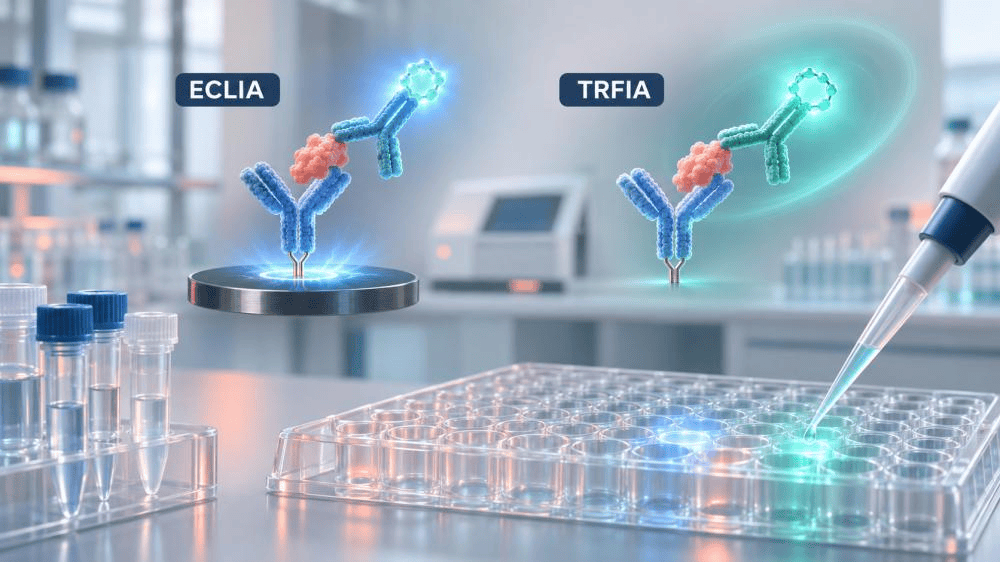
Detecting a low-abundance biomarker is only part of the challenge in assay development. Laboratory teams also need a method that performs consistently in the intended sample matrix, fits available instrumentation, and supports a manageable workflow. Creative Biolabs offers custom immunoassay development services to help researchers address these connected requirements, including electro chemiluminescence immunoassay (ECLIA) and time-resolved fluorescence immunoassay (TRFIA).
Platform selection should begin with a practical specification: the target analyte, expected concentration range, available sample volume, and required sample throughput. A method suitable for an exploratory study may need further development before it can support repeated measurements across larger sample sets.
Creative Biolabs’ immunoassay development capabilities span several detection technologies, allowing discussions to start with the application rather than a predetermined platform. For projects considering ECLIA or TRFIA, a useful starting question is how each approach separates the analytical signal from background and whether that advantage translates into reproducible quantification in representative samples.
ECLIA uses an applied electrical potential to trigger light emission from suitable labels, commonly ruthenium complexes. This controlled excitation provides a route to sensitive measurements with low optical background. The platform can be considered when development priorities include a broad measurement range, limited sample availability, or compatibility with automated workflows.
Through its ECLIA-based kit development service, Creative Biolabs supports antibody selection, labeling, solid-phase optimization, and reagent formulation. Development also includes assessment of analytical characteristics such as linearity and reproducibility.
For a laboratory evaluating this route, instrument compatibility deserves early attention. Electrode configuration, separation steps, and reagent handling form part of the assay system. Performance targets should therefore be assessed using the proposed workflow and representative samples, rather than inferred from the detection principle alone.
TRFIA takes a different approach. Lanthanide labels, such as europium or terbium chelates, produce fluorescence that persists longer than much of the short-lived background fluorescence. Introducing a delay between excitation and measurement allows the reader to capture the longer-lived signal while reducing this background contribution.
Creative Biolabs’ TRFIA-based kit development service covers antigen and antibody selection, lanthanide labeling, assay optimization, and validation. Available development options include sandwich, competitive, and multiplex formats.
This approach offers a useful option for teams exploring fluorescence-based quantification in complex samples. However, time-gated detection does not replace the need for selective binding reagents or appropriate sample preparation. Reader capabilities, label selection, and assay format still need to be matched to the intended application.
ECLIA is worth evaluating when compatible electrochemiluminescence instrumentation is available and the proposed workflow can meet sample-volume, throughput, and measurement-range requirements. TRFIA is worth evaluating when a suitable time-resolved fluorescence reader is available and short-lived fluorescence background is a material concern. Both approaches require application-specific verification.
The principal difference is how the signal is generated and read. ECLIA commonly uses ruthenium labels and requires a compatible electrochemiluminescence detection system; development must account for electrode and reaction chemistry, separation steps, and workflow integration. TRFIA commonly uses lanthanide chelates and requires a fluorescence reader with suitable time-resolved detection; label chemistry, the delay after excitation, and the signal integration time must be optimized together. These requirements should be assessed against the laboratory’s equipment and intended assay format.
Neither approach is inherently superior for every low-abundance biomarker. If both are feasible, compare their quantification limits, precision, interference, and operational requirements in the intended sample matrix. Instrument access can narrow the shortlist; demonstrated analytical performance should guide the final choice.
A practical evaluation plan should define the required limit of quantification (LOQ), acceptable precision and bias at relevant concentrations, and the intended analytical measurement range. Detecting a signal above background does not establish that the concentration can be quantified reliably. The LOQ should reflect predefined performance criteria in the intended matrix, with the effects of sample dilution included when interpreting concentrations in the original sample.
Development milestones should address interference and cross-reactivity, dilutional parallelism, spike recovery, and consistency between runs and reagent lots. Bias assessment requires suitable reference material or a justified comparator where available; spike recovery alone does not establish accuracy for endogenous analytes. Representative samples are essential for assessing matrix effects that buffer-based standards may not reveal.
Operational requirements matter alongside analytical performance. Laboratories should consider manual steps, sample consumption, reagent storage, calibration, and compatibility with existing equipment and staff capacity. A promising prototype needs a workable routine before it can become a dependable research tool.
Researchers developing assays for low-abundance biomarkers can consult Creative Biolabs about ECLIA- and TRFIA-based development options. Share the target analyte, sample matrix, expected concentration range, available sample volume, instrumentation, and analytical performance requirements to begin evaluating a suitable development strategy.
Explore Creative Biolabs’ custom immunoassay development services to discuss project feasibility and technical requirements. These details provide a concrete starting point for defining project scope, validation priorities, and development milestones.
For research use only.
Explore Creative Biolabs' custom immunoassay development services