
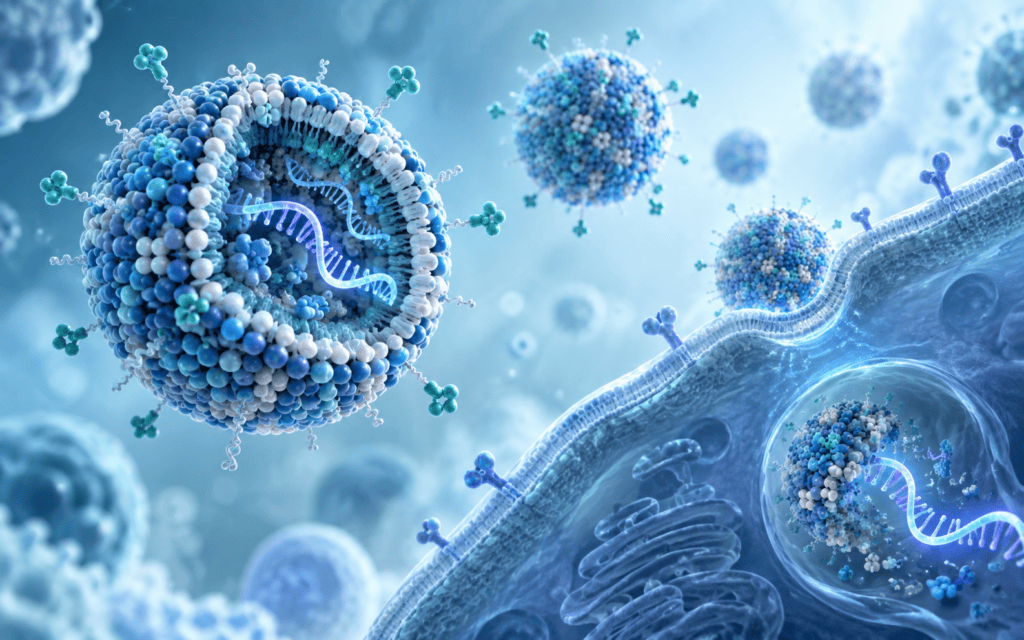
As RNA therapeutics advance toward increasingly sophisticated applications, effective delivery remains one of the central challenges in translating nucleic acid design into functional performance.
Creative Biolabs is expanding its lipid-based delivery capabilities to support researchers with LNP formulation development, lipid nanoparticle optimization, liposome formulation development, and customized RNA delivery strategies for mRNA, self-amplifying RNA (saRNA), and other nucleic acid payloads.
The expanded services are designed for research teams seeking payload-specific nucleic acid delivery systems rather than one-size-fits-all formulations, particularly as emerging RNA modalities introduce new requirements for stability, cellular uptake, endosomal escape, and functional expression.
Effective lipid nanoparticle development involves more than loading RNA into a carrier. LNP development typically requires coordinated optimization of particle size, encapsulation efficiency, stability, cellular uptake, endosomal escape, and functional expression.
These variables are interconnected. Changes in lipid composition or formulation conditions can influence particle characteristics and, ultimately, RNA delivery performance. Reviews of LNP-based mRNA delivery have similarly emphasized the importance of coordinating RNA engineering with nanoparticle design, stability, and biological performance.
Creative Biolabs supports lipid nanoparticle development and liposome-encapsulated nucleic acid development, helping researchers investigate formulations according to specific payloads and experimental objectives.
Depending on project requirements, formulation development and characterization can address parameters such as:
These physicochemical parameters are widely used to characterize lipid-based RNA delivery systems; encapsulation efficiency, for example, describes the proportion of RNA successfully incorporated into the nanoparticle carrier, while zeta potential provides information about particle surface charge.
A practical LNP formulation development strategy starts with the payload. RNA type, molecular characteristics, target cells, route of administration, and intended experimental endpoint can all affect carrier requirements.
For researchers developing mRNA delivery, saRNA delivery, or other nucleic acid delivery systems, several considerations can guide formulation development:
For example, an mRNA-LNP formulation may achieve high encapsulation efficiency yet produce limited protein expression. Increasing the RNA concentration alone may therefore fail to address the underlying bottleneck. Instead, researchers may need to examine lipid composition, cellular uptake, endosomal escape, intracellular cargo release, or RNA stability.
Creative Biolabs can integrate formulation variables and physicochemical characterization into a coordinated screening and optimization workflow, helping researchers identify potential performance bottlenecks more systematically.
The interaction between RNA design and carrier engineering becomes particularly important for emerging modalities such as saRNA. Unlike conventional mRNA, saRNA contains replication machinery that enables intracellular RNA amplification, creating distinct opportunities as well as formulation and immunological considerations.
As an extension of its focus on RNA delivery and formulation development, Creative Biolabs will host the webinar Engineering saRNA Delivery Systems for Therapeutics on October 20, 2026, from 12:00 PM to 1:00 PM EDT, featuring Dr. Anna Blakney, Associate Professor at the University of British Columbia.
The webinar will examine how molecular engineering and biomaterial design can be considered together when developing saRNA delivery strategies, with topics including:
The broader lesson for RNA therapeutics development is that the nucleic acid and its delivery vehicle should not always be optimized as independent components. Recent research continues to demonstrate that RNA properties, innate immune responses, and lipid-based delivery design can interact to influence overall system performance.
As mRNA, saRNA, and other nucleic acid technologies diversify, formulation requirements are becoming increasingly application-specific. Combining payload-informed design with LNP formulation screening, physicochemical characterization, stability assessment, and lipid nanoparticle optimization can provide a more systematic route toward identifying promising delivery systems.
Researchers developing mRNA, saRNA, or other nucleic acid therapeutics can contact Creative Biolabs to discuss customized LNP formulation, screening, characterization, and delivery optimization strategies or explore its lipid-based delivery solutions and webinar resources on our website.
About Creative Biolabs
Creative Biolabs provides customized biotechnology solutions supporting global researchers in lipid-based delivery, nucleic acid research, formulation development, and advanced therapeutic research.
Explore its lipid-based delivery solutions and webinar resources