


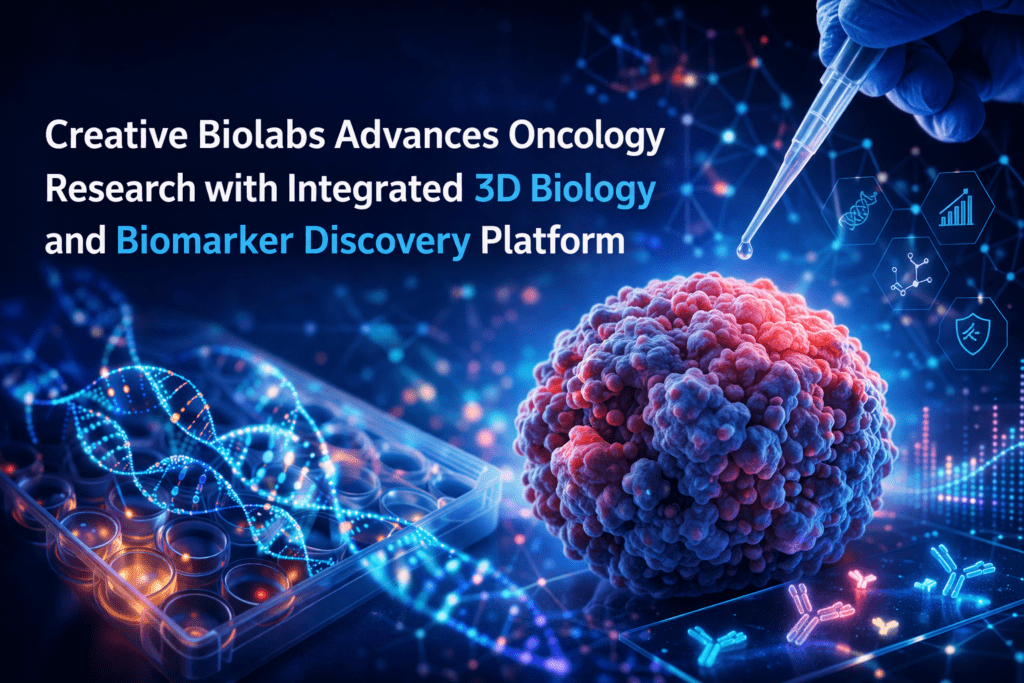
Creative Biolabs, a global leader in biotechnology contract research, today announced the expansion of its integrated 3D Biology platform.
By synchronizing advanced 3D spheroid and organoid modeling with specialized biomarker discovery services and a vast repository of human body fluids, the company is bridging the critical gap between traditional in vitro assays and clinical realities in drug development.
The limitations of two-dimensional (2D) cell culture—such as flat cell morphology and lack of cell-to-matrix interactions—often lead to low predictivity in clinical trials. Creative Biolabs’ 3D models address these challenges by replicating the complex spatial architecture of human tissues.
“Traditional models frequently fail because they don’t capture the nutrient gradients and oxygen tension found in real tumors,” stated a senior scientist at Creative Biolabs. “Our 3D spheroid and organoid models provide the structural fidelity required to simulate metastasis, angiogenesis, and drug resistance accurately.”
A cornerstone of the new platform is the 3D Biology-Based Biomarker Discovery Service. Unlike 2D methods, 3D systems allow researchers to identify clinically meaningful indicators by maintaining the “natural milieu” of the disease.
Creative Biolabs utilizes a multi-omics approach—including transcriptomics and proteomics—to analyze 3D cell aggregates. This ensures that the biomarkers discovered are not artifacts of a plastic culture dish but are representative of human biological responses.
To assist researchers in navigating these emerging technologies, Creative Biolabs has synthesized key technical clarifications:
How do 3D models differ from 2D in drug sensitivity?
Cells in 3D structures are often less sensitive to cytotoxins than 2D cultures, more closely mimicking in vivo drug resistance—a vital factor in avoiding “false positive” results during early-stage screening.
What is the success rate of organoid construction?
Organoids offer a high construction success rate and fast culture speed. The timeline from sample collection to actionable drug sensitivity results is typically controlled within two weeks.
Can 3D models replace animal testing?
While animal models remain a standard, 3D biology significantly reduces reliance on them by fixing the limitations of cell-cell interaction and reducing the high costs associated with large-scale animal experiments.
About Creative Biolabs
Creative Biolabs is a CRO specializing in 3D biology technologies. With an expert team dedicated to cell biology, the company provides end-to-end solutions ranging from ready-to-use 3D models to bespoke multi-omics analysis, accelerating the global research for innovative therapies.