


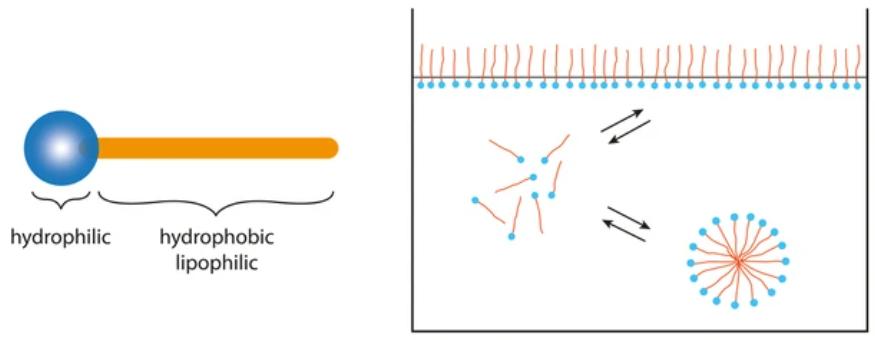
The high-performance liquid chromatography (HPLC) method serves as a vital analytical tool for separating and identifying surfactant components while also quantifying their presence in different mixtures. Surfactants, which belong to the amphiphilic molecule class, create interfaces between water and oil and find extensive application across industrial sectors, personal care products, and biomedical science.
HPLC achieves separation by exploiting distribution coefficient variations among sample components across the mobile phase and stationary phase. The sample components enter the chromatographic system through injection and then distribute between the mobile phase and stationary phase multiple times depending on their chemical properties like polarity and hydrophilicity/hydrophobicity. Each component moves through the chromatographic column at different rates, which results in varying retention times. The detector detects and records each component as they exit the column according to their retention times.
Components of an HPLC System and Their Roles
1. Solvent Reservoir
Function: The reservoir holds the mobile phase solvent and ensures a consistent supply throughout the system.
Role: Clean and stable mobile phase composition is crucial because it serves as the primary medium for sample separation, which impacts separation performance.
2. Pump
Function: The pump moves the solvent through the chromatographic column according to specified pressure and flow rate parameters.
Role: The system maintains consistent mobile phase flow against column resistance through high pressure delivery.
3. Injector
Function: Injects the sample into the mobile phase.
Role: Sample dissolution in the mobile phase is required before it enters the chromatographic column for separation. The injector design plays a critical role in determining the efficiency of sample introduction and the quality of peak shapes.
4. Chromatographic Column
Function: The chromatographic column’s primary function for separation depends on interactions between the stationary phase and sample components.
Role: Separation efficiency in chromatographic columns depends greatly on the type of packing material used (e.g., C18, NH2) as well as particle size and column length. NH₂ columns serve as a standard choice for the separation of carbohydrate compounds.
5. Detector
Function: The system observes and logs the component signals that develop within the chromatographic column.
Role: Selecting a detector relies on the specific properties of the compound being analyzed. UV detectors (UV), fluorescence detectors (FL), and mass spectrometry detectors (MS) represent the main types of common detectors.
6. Data Processing System
Function: The data processing system captures detector signals to produce chromatograms.
Role: Software analysis of chromatograms enables calculation of component concentration, retention time, and peak area.
7. Connecting Tubes and Fittings
Function: Links various components of the system to maintain uninterrupted movement of samples and solvents.
Role: High-quality tubing and fittings minimize leakage and contamination to maintain accurate analytical results.
The analysis of surfactants using HPLC requires these essential steps:
1. Sample Preparation and Injection
The first essential stage of HPLC analysis consists of sample preparation, which ensures the sample dissolves well and remains uncontaminated before it enters the chromatography column. Technical procedures encompass sample collection followed by filtration and dilution along with the selection of the appropriate solvent. The chosen solvent must dissolve the sample fully without introducing contaminants or disrupting the chromatography column. After sample preparation, the injector unit uses either a syringe or an automatic sampler to introduce it into the mobile phase.
2. Selection of Mobile and Stationary Phases
The properties of the sample and the separation requirements determine which mobile phase should be selected. A suitable solvent or solvent blend that readily dissolves the sample must be chosen to maintain compatibility with the stationary phase. The selection of stationary phase depends on the sample’s chemical makeup and the target analyte’s unique properties. Reverse-phase C18 and ion-exchange resins represent typical stationary phases used in the separation process. The mobile phase composition (including pH value and salt concentration) and gradient elution conditions require optimization according to the sample characteristics.
3. Detection Methods and Their Suitability for Surfactants
The most common detectors for HPLC analysis are UV-Vis detectors as well as fluorescence detectors and mass spectrometers. The choice of detector depends on specific characteristics of the target analyte, including absorption spectrum, fluorescence properties, and electrochemical reactivity. Surfactants require UV-Vis detectors and mass spectrometers for accurate qualitative and quantitative analysis because their complex molecular structures demand precise detection methods.
The core process of surfactant HPLC analysis emerges from these steps, which secure both accuracy and reliability of the results.
Understanding Retention Times and Chromatograms
Retention Time: The retention time measures the duration from sample injection to its detection by the detector. In chromatographic analysis, this parameter serves as a fundamental element for both separating and identifying various components. Retention time duration varies based on how strongly the sample component interacts with both the stationary phase and the mobile phase.
Chromatogram: The chromatogram represents a graph that shows how the detector response correlates with retention time. Individual chromatographic peaks correspond to distinct analyte components in the sample. The separation and identification of sample components becomes possible through the examination of chromatogram peaks.
Qualitative Analysis: The presence of a specific surfactant component in the sample can be initially verified by matching the sample’s retention time to that of a standard. When retention times remain constant, it indicates that the particular component is present in the sample. Retention time alone cannot fully confirm the component because distinct molecules might share identical retention periods.
Quantitative Analysis: The analysis of each component’s concentration in the sample becomes possible through measurements of the chromatographic peak area or height. Quantitative analysis of chromatographic peaks requires calibration curves or internal standard methods to adjust for the detector’s response.
The main focus of recent developments in HPLC surfactant analysis technology has been to advance sensitivity levels and resolution performance along with detection technology improvements. Here are some of the latest developments:
Application of Ultra-High-Performance Liquid Chromatography (UHPLC): UHPLC achieves faster separation speeds and enhanced resolution through its use of small particle size packing materials and a high-pressure system. UHPLC performs analyses faster than traditional HPLC while also providing greater sensitivity and separation power. The pharmaceutical industry widely uses UHPLC because it provides better separation efficiency and faster analysis times during drug analysis.
Development of New Chromatographic Column Materials: The creation of innovative chromatographic column materials has improved the separation efficiency and resolution capabilities of HPLC. Acclaim columns demonstrate superior separation abilities for anionic, cationic, amphoteric, and non-ionic surfactants, which results in their high suitability for UV detection and Electrospray Ionization (ESI). The use of ion-pair reagents such as Sodium 1-Dodecyl Sulfate improves both retention and detection sensitivity for certain surfactants.
Introduction of Multidimensional Chromatography: Multidimensional chromatography utilizes multiple separation dimensions to achieve better component separation in complex samples. This technology demonstrates substantial benefits for analyzing drug residues and surfactant structural identification.
UV-Vis Spectroscopic Detector: HPLC UV detectors are the most frequently employed detection systems that work well with compounds possessing UV absorption properties.
Mass Spectrometry Detector (MS): The joint application of HPLC and Mass Spectrometry (LC-MS) delivers comprehensive molecular structural details and composition insights, which are essential for both quantitative and qualitative evaluations of complex samples.
Electrospray Ionization (ESI) and Atmospheric Pressure Chemical Ionization (APCI): The sensitivity and accuracy of surfactant detection is improved when HPLC is paired with these ionization techniques.
The accuracy and reliability of HPLC for surfactant analysis depend on proper calibration alongside validation and standardization of quality control measures.
1. HPLC System Calibration
The HPLC system requires calibration to achieve accurate and precise measurements. Quality control standards require the calibration process to verify key component performance, including the pump, detector, and column oven. The specific steps are as follows:
Pump Calibration: Make sure the pump’s flow rate remains stable and consistent with the predetermined value to verify its accuracy.
Detector Calibration: Standard substances like caffeine help calibrate detector wavelength and linearity, which maintains detector sensitivity and accuracy.
Column Oven Calibration: The column oven temperature must be set and verified for stability to maintain a stable temperature during the analysis.
Regular Calibration: Calibration should be performed routinely considering how often the instrument is used and its maintenance requirements, with a standard timeframe of every six months or following any significant malfunctions.
High-precision flow rate verification instruments like the JGC 5002500 improve both calibration accuracy and efficiency when used correctly.
2. Method Validation
The HPLC analysis method requires validation to determine its suitability for specific applications. The validation parameters encompass linearity, precision, accuracy, specificity, detection limit (LOD), quantification limit (LOQ), and robustness. The specific steps are as follows:
Linearity Validation: To validate linearity, plot a standard curve between sample concentrations and peak areas and confirm that the correlation coefficient (R²) reaches the required standard.
Precision Validation: To establish repeatability and intermediate precision, it is necessary to conduct several measurements of standard solutions and use the coefficient of variation (CV) to confirm that precision meets acceptable limitations.
Accuracy Validation: Spiking recovery experiments validate the method’s accuracy by confirming recovery rates stay between 90% and 110%.
Specificity Validation: The analytical method must be able to specifically identify the target compound while preventing any cross-reaction with interfering substances.
Robustness Validation: Test the method’s performance among various labs and operators and with different instruments to achieve uniform results.
3. Quality Control
Reliable HPLC analysis results depend on proper quality control implementation. Key measures include:
Use of Standards: Ensure the standard curve’s accuracy by calibrating and validating with high-purity standards that possess purity levels greater than 98%.
Blank and Recovery Samples: System performance testing must be conducted with blank and recovery samples before each analysis session to confirm adherence to all required performance standards.
Regular Quality Control: Develop a quality control program that regularly evaluates instrument performance and checks the dependability of analysis outcomes.
Documentation and Traceability: Maintain detailed records of calibration procedures along with validation and analysis data to establish result traceability.
4. Standard Operating Procedures (SOP)
The development and adherence to Standard Operating Procedures (SOP) forms the core foundation for achieving consistency and reliability in HPLC analysis. SOPs should include the following:
Sample Preparation: Establish detailed procedures for sample extraction, dilution and filtration to maintain sample purity and stability.
Instrument Setup: Maintain detailed records of flow rate and column temperature along with mobile phase parameters for every analysis to achieve consistency.
Data Processing: The software must be used for both data processing and result calculations to maintain consistency and objectivity in results.
The analysis of surfactants in HPLC faces challenges with inadequate detection sensitivity and poor separation resolution in addition to complicated sample preparation procedures.
1. Insufficient Detection Sensitivity
Problem Description: The inherent high polarity and low thermal stability of surfactants produce reduced detection sensitivity when analyzing complex matrices. The detection process becomes more difficult because surfactant samples contain isomers and impurities.
Solution: Employing detectors with high sensitivity, such as mass spectrometry (MS) or fluorescence detectors, leads to substantial enhancement of detection sensitivity. A system that combines HPLC with an MS detector delivers improved sensitivity and selectivity.
Optimizing Column Material and Mobile Phase: The use of Thermo Scientific Acclaim Surfactant Plus columns or other efficient silica-based columns with low leakage and high selectivity provides optimal separation for various surfactants.
Use of Alternative Solvents: Alternative solvents like dimethyl sulfoxide and acetonitrile help improve detection sensitivity by minimizing interference in certain situations.
2. Low Separation Resolution
Issue Description: The intricate molecular structure of surfactants together with their isomeric forms results in limited resolution during separation processes, which becomes particularly problematic in nonionic surfactant analysis. The presence of impurities and matrix components within the sample can cause the target compound’s peak to become obscured.
Solution: Modifying the pH level alongside salt and surfactant concentrations in the mobile phase leads to better separation efficiency.
Use of Two-dimensional HPLC: The application of two-dimensional HPLC, which begins with ion chromatography followed by reversed-phase chromatography, enables effective separation of intricate surfactant mixtures.
Choose the Appropriate Chromatographic Column: The selection of columns designed explicitly for surfactants, such as the Acclaim Surfactant column, enhances both separation efficiency and resolution.
3. Complex Sample Preparation
Problem Description: The analysis of surfactant samples demands intricate pre-treatment processes, including filtration, dilution, and extraction to eliminate impurities and achieve both accuracy and reproducibility. High surfactant concentrations in samples pose a risk of contaminating the HPLC system.
Solution: Selecting HPLC system-compatible solvents such as dimethyl sulfoxide or acetonitrile during sample preparation minimizes potential interference.
Optimize Sample Dilution Ratio: Applying suitable dilution ratios decreases surfactant concentration in samples, which helps prevent system contamination.
Adopt Automated Sample Preparation Techniques: Automated equipment for sample preparation reduces human error while enhancing operational efficiency.
1. Baseline Noise and Peak Tailing
Improper sample preparation methods and the aging process of the chromatographic column usually cause these issues. These difficulties can be resolved through routine calibration of instruments and timely replacement of chromatographic columns.
2. Poor Thermal Stability
When analyzing surfactants that degrade under heat, researchers should opt for low-temperature conditions to prevent breakdown during analysis.
3. Multi-component Analysis
Ultra-performance liquid chromatography (UPLC) and supercritical fluid chromatography (SFC) represent advanced methods that achieve better efficiency and selectivity for samples with multiple surfactants.
Surfactant Testing