



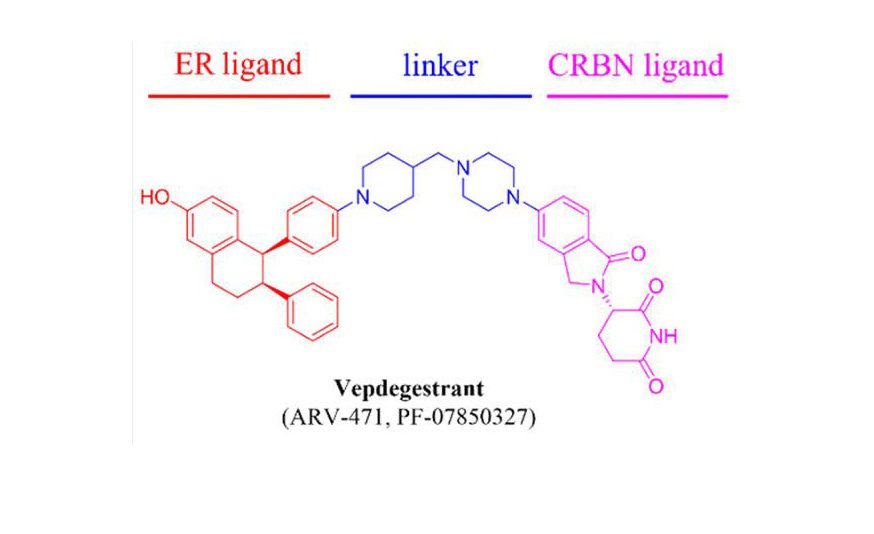
The FDA approval of vepdegestrant (Veppanu, ARV-471) marks a major milestone for targeted protein degradation, introducing the first PROTAC therapy for patients with ER-positive, HER2-negative, ESR1-mutated advanced breast cancer. The decision represents an important validation of PROTAC technology as a clinically viable therapeutic modality and reinforces growing scientific interest in its underlying molecular design.
PROTACs (Proteolysis Targeting Chimeras) function through a mechanism distinct from conventional small-molecule inhibitors. Instead of blocking protein activity, they induce selective degradation of the protein of interest (POI) by recruiting an E3 ubiquitin ligase, leading to ubiquitination and subsequent destruction via the ubiquitin-proteasome system. This event-driven mechanism enables repeated catalytic cycles of target degradation and expands the range of druggable proteins beyond traditional approaches.
A PROTAC molecule consists of three components: a POI-binding ligand, an E3 ligase recruiter, and a chemical linker connecting both ends. While much attention is often placed on the binding ligands, increasing evidence shows that the linker plays a decisive role in overall activity. Linker properties such as length, flexibility, polarity, and attachment geometry directly influence ternary complex formation, cellular permeability, and degradation efficiency.
In current PROTAC design strategies, flexible linkers are most widely used, including alkyl chains and PEG-based structures. Among these, PEG linkers are frequently selected due to their tunable length, hydrophilicity, and functional versatility. PEG chains can improve solubility and enable systematic optimization of spatial orientation between the two binding motifs, which is critical for productive ternary complex formation.
At the same time, linker optimization remains a balance of multiple factors. While PEG-based linkers offer advantages in flexibility and aqueous compatibility, alternative linker types such as rigid or semi-rigid scaffolds are also used to fine-tune selectivity and pharmacokinetic behavior. The choice of linker therefore remains highly context-dependent and is often determined empirically during lead optimization.
The approval of vepdegestrant is expected to accelerate further development in the field of targeted protein degradation. As more PROTAC candidates advance into clinical studies, demand for well-defined linker building blocks, including PEG-based reagents with controlled chain length and functionalization, is likely to increase across medicinal chemistry programs.
To support targeted protein degradation research, Biopharma PEG Scientific provides a comprehensive portfolio of high-purity PEG derivatives for linker development. The product portfolio includes monodisperse PEG linkers with multiple chain lengths and functional groups suitable for PROTACs, molecular glues, antibody-drug conjugates (ADCs), peptide-drug conjugates (PDCs), and other bioconjugation applications. Custom synthesis services are also available for researchers requiring specialized linker structures.
The development also underscores a broader trend in modern drug discovery: the increasing importance of molecular engineering at the linker level, where small structural adjustments can significantly impact biological outcomes.
