



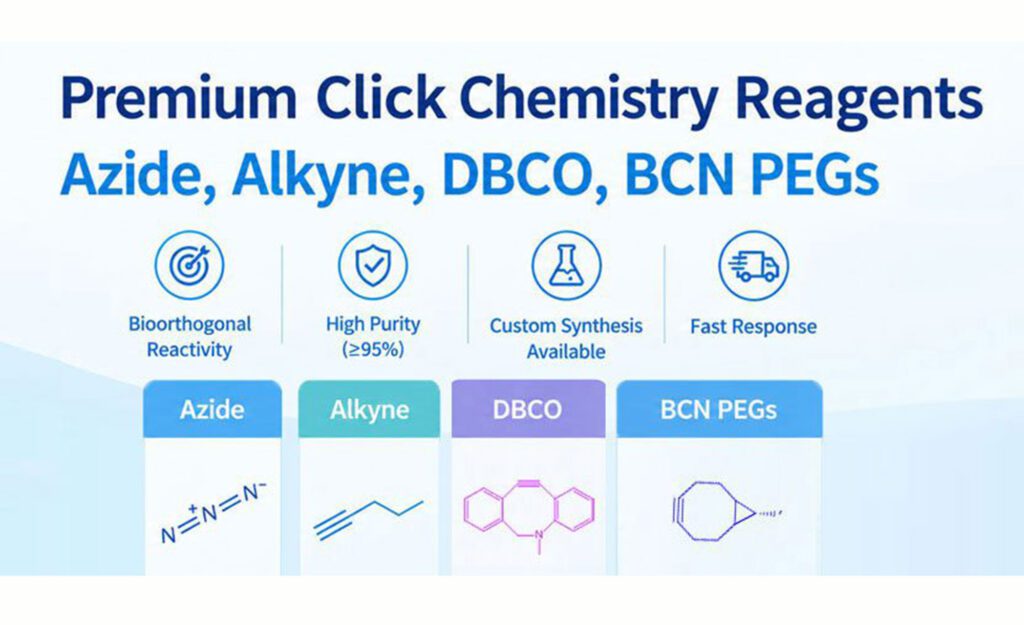
Functionalized polyethylene glycol (PEG) linkers are widely used in bioconjugation, molecular labeling, drug delivery research, and chemical biology. Selecting an appropriate PEG linker involves more than choosing a chain length. The reactive group, PEG architecture, molecular weight, and overall linker structure can all influence how a conjugation strategy is designed.
For researchers working with click chemistry, functionalized PEGs provide a convenient way to introduce reactive groups while maintaining a hydrophilic spacer between molecular components.
Different click chemistry approaches require different reactive groups.
The choice between these approaches depends on the experimental system, the biomolecules involved, and the reaction conditions required.
The PEG segment can also be selected according to the requirements of the application.
Short PEG spacers can provide relatively compact structures, while longer PEG chains can provide greater separation between functional groups. Monodispersed PEGs, with defined numbers of ethylene glycol units, can be useful when a precise linker structure is important. Polydispersed PEGs provide another option when a broader molecular-weight distribution is acceptable.
Different architectures, including linear and multi-arm PEGs, can also be used to introduce one or multiple functional groups into a molecular system.
In addition to click chemistry groups, functionalized PEG linkers can contain reactive groups such as amine, thiol, NHS ester, maleimide, and carboxylic acid.
These functional groups can support different conjugation and crosslinking strategies involving proteins, peptides, small molecules, fluorescent probes, and other research materials.
Biopharma PEG Scientific Inc. provides a range of functionalized PEG derivatives covering different molecular weights, PEG chain lengths, architectures, and terminal groups. Its portfolio includes azide, alkyne, DBCO, and BCN PEGs, together with other functional PEG building blocks for bioconjugation and related research.
“We hope to provide high-purity PEG linkers that give researchers practical choices for their specific chemistry and application,” said a chemist at Biopharma PEG. “The right PEG structure can be an important part of developing a reproducible conjugation strategy.”
Not every research project can be addressed with a standard linker. Some applications require a particular PEG length, terminal group, molecular architecture, or combination of functionalities.
Alongside its catalog of PEG derivatives, Biopharma PEG provides custom synthesis for researchers requiring specific PEG structures. The company supplies both monodispersed and polydispersed PEG derivatives for applications in bioconjugation, chemical biology, drug delivery research, and related areas.
By combining different PEG architectures and functional groups, researchers can select linker structures according to their experimental requirements rather than relying on a single PEG format.
About Biopharma PEG
Biopharma PEG Scientific Inc. provides PEG derivatives, functionalized PEG linkers, and custom PEG synthesis services for academic, biotechnology, and pharmaceutical research. Its portfolio includes monodispersed, polydispersed, and multi-arm PEG derivatives covering a broad range of molecular weights and functional groups.