Dr. Sofie Thijs (Research Coordinator at UHasselt), Prof. Dr. Jaco Vangronsveld (Centre for Environmental Sciences, UHasselt), Francis Claes (Project Manager at Globachem), and Liesbeth Vogels (R&D Project Manager at Globachem) | Photo: UHasselt
UHasselt research shows that bacteria have potential for use in crop protection. Crop protection company Globachem, based in Sint-Truiden (Belgium), has now signed a license agreement with the university to further test two bacterial strains for their potential against fungal diseases.
Since 2017, UHasselt and Globachem have collaborated on research into new forms of crop protection. Globachem has already tested more than one hundred bacteria from the extensive UHasselt collection through research licenses. Two bacteria are now included in a commercial license to be further evaluated—following successful greenhouse trials—through field studies for their capacity to protect crops. This marks an important step toward the development of a new biological product for environmentally friendly agricultural applications.
This is the first time that a company is using bacteria from UHasselt’s plant research to develop a new agricultural product. “A very significant recognition of our many years of research into plant–bacteria interactions. Especially if this can lead to a new biological product capable of protecting crops,” say Dr. Sofie Thijs and Prof. Dr. Jaco Vangronsveld of the Centre for Environmental Sciences.
“We are searching for bacteria that strengthen plants—the so-called beneficial endophytes or plant probiotics”
Over recent decades, UHasselt has invested in research on interactions between bacteria and plants, focusing on enhancing plant resilience and their capacity to degrade contaminants in soil and groundwater. To date, UHasselt biologists have identified more than 3,000 individual bacteria, originating from soil samples as well as plant roots, seeds, leaves, and fruits from various crops and locations worldwide.
Database of 3,000 bacteria
UHasselt now possesses an extensive bacterial database. According to the researchers, soil appears to be an almost inexhaustible source, offering numerous opportunities to identify sustainable alternatives. “A single teaspoon of soil can contain millions of bacteria, all coexisting in a complex system with plants,” says Dr. Sofie Thijs. “The challenge is to identify those bacteria that strengthen plants—the so-called beneficial endophytes or plant probiotics. These help plants better withstand stress factors such as pollution, diseases, or adverse growth conditions including drought or excess water, heat or cold, and nutrient stress. Our understanding of these underlying mechanisms has formed the foundation of our research for many years.”
The two bacteria included in the commercial license were selected by Globachem based on their potential to enhance plant resistance against harmful fungi. Their mode of action is twofold: the bacteria strengthen the plant and can combat potential plant diseases by directly targeting harmful bacteria or fungi that colonize plants.
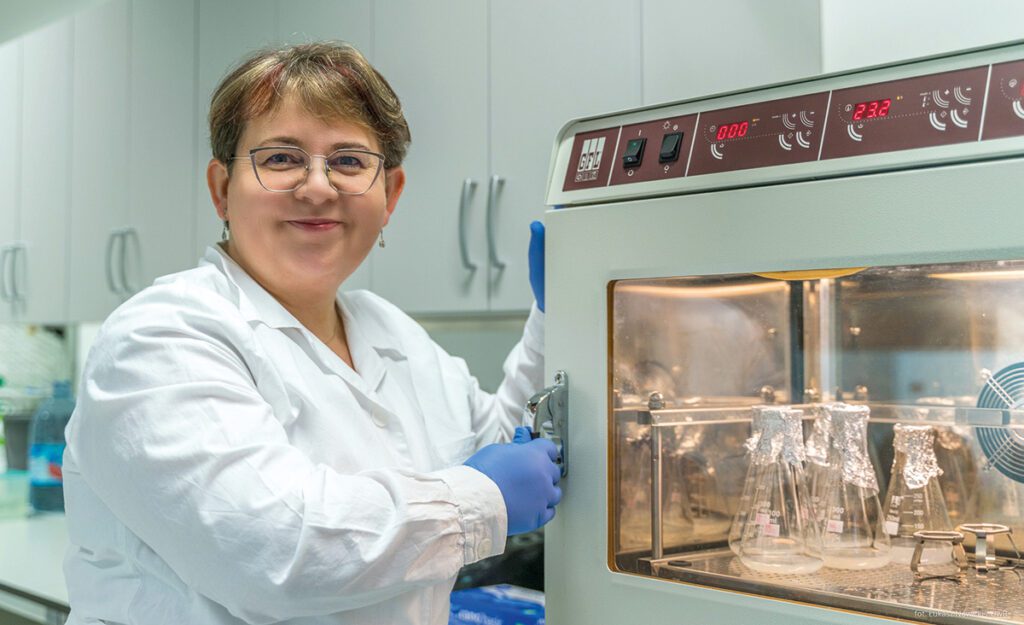
Dr. hab. Ewa Olenska of the University of Białystok next to an incubator with bacterial samples | Photo: University of Białystok
One bacterium was isolated from a soil sample in Belgium, the other from Poland, in collaboration with researchers from the University of Białystok. The fact that both bacteria originate from different environments and show promising results suggests broad applicability. Further development of these bacteria will require several years of applied research to determine optimal formulation, application methods, and validation. “If these results are confirmed, this will lead to new products contributing to sustainable agriculture and more resilient crop production under changing climate conditions. This collaboration with Hasselt University underscores our ambition to translate science and innovation into sustainable solutions for growers,” says Francis Claes, Project Manager at Globachem.
“Knowledge we have built up over many years can evolve into concrete applications and be taken up by a company willing to develop it further”
“The proof of the pudding is in the eating.” In the coming years, practice will determine whether these sustainable alternatives for crop protection also have large-scale potential. “With this commercial license, we now see that our fundamental research can evolve into concrete applications with societal and economic relevance. It is highly motivating to see that knowledge built up over many years of fundamental research not only leads to scientific publications, but can also grow into tangible applications and be taken up by a company willing to develop it further,” says Prof. Dr. Jaco Vangronsveld.
This sense of satisfaction is also shared by the Polish research partner. “The scientific collaboration between UHasselt and the University of Białystok in Poland has provided us with better insight into how plants and microorganisms interact. It is rewarding to see this knowledge now being translated by Globachem into potential applications. For me, it is important that scientific research also contributes to solutions that advance society,” says Dr. hab. Ewa Olenska of the University of Białystok.