



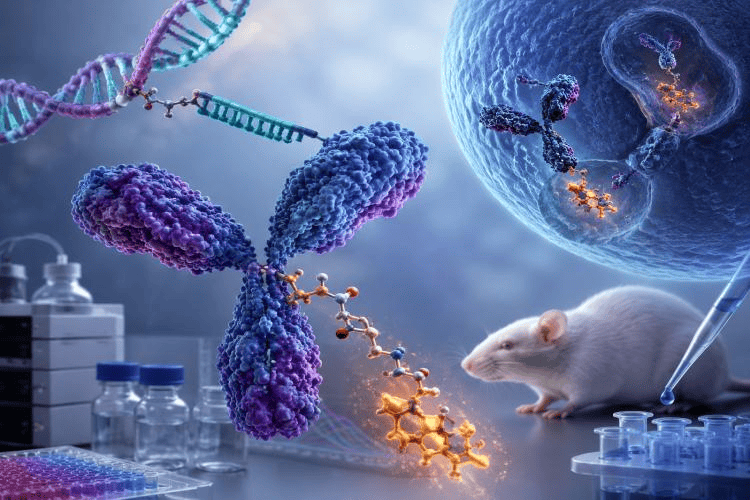
As bioconjugate modalities continue to expand beyond conventional antibody-drug conjugates (ADCs), research teams increasingly require integrated approaches that connect chemical design, conjugation strategies, and preclinical evaluation. Optimizing a bioconjugate candidate involves more than selecting a targeting molecule or payload; factors such as linker stability, conjugation chemistry, drug-to-antibody ratio (DAR), biodistribution, and biological performance all influence development decisions.
Creative Biolabs provides integrated bioconjugation research services supporting custom linker-payload synthesis, ADC in vivo analysis, and antibody-oligonucleotide conjugate (AOC) development. These capabilities are designed to help biotechnology and pharmaceutical researchers evaluate and refine targeted delivery candidates during early-stage development.
Linker-payload architecture plays an important role in determining ADC characteristics, including stability, release behavior, and conjugation compatibility. Creative Biolabs supports custom linker-payload synthesis workflows by addressing key design considerations across payload chemistry, linker selection, and conjugate optimization.
Payload evaluation may include microtubule-disrupting agents, DNA-damaging compounds, topoisomerase inhibitors, and other research-grade cargos. Linker optimization focuses on balancing stability in systemic circulation with controlled payload release under appropriate biological conditions. Additional factors, including hydrophobicity, aggregation tendency, conjugation sites, and DAR distribution, can also be considered during development.
Following molecular design and in vitro characterization, ADC in vivo analysis provides critical insights into exposure, distribution, and biological behavior. Creative Biolabs supports fit-for-purpose preclinical workflows designed according to study objectives and candidate characteristics.
Depending on research requirements, ADC evaluation may include pharmacokinetic analysis, biodistribution assessment, tolerability observations, and measurement of different circulating species, including total antibody, intact ADC or conjugated antibody, and free payload. These analytical strategies help researchers better understand conjugate stability, payload release, and candidate performance.
Beyond ADCs, antibody-oligonucleotide conjugates (AOCs) represent an emerging approach for targeted delivery of nucleic acid cargos such as siRNA and antisense oligonucleotides (ASOs). AOC development requires coordinated optimization of antibody targeting, oligonucleotide chemistry, conjugation control, and functional evaluation.
Creative Biolabs supports integrated AOC development workflows, including targeted conjugation strategies, analytical characterization, and functional assessment. Key considerations include receptor-mediated uptake, conjugation site selection, oligonucleotide stability, and intracellular delivery mechanisms.
As targeted therapeutic platforms continue to diversify, successful bioconjugate development increasingly depends on combining precise chemical engineering with reliable analytical evaluation. Through flexible support across linker-payload design, ADC characterization, and AOC development, Creative Biolabs helps research teams generate actionable data for advancing next-generation bioconjugate programmes.
What factors should be considered when selecting an ADC linker-payload?
What can be evaluated during ADC in vivo analysis?
What are the major challenges in AOC development?
