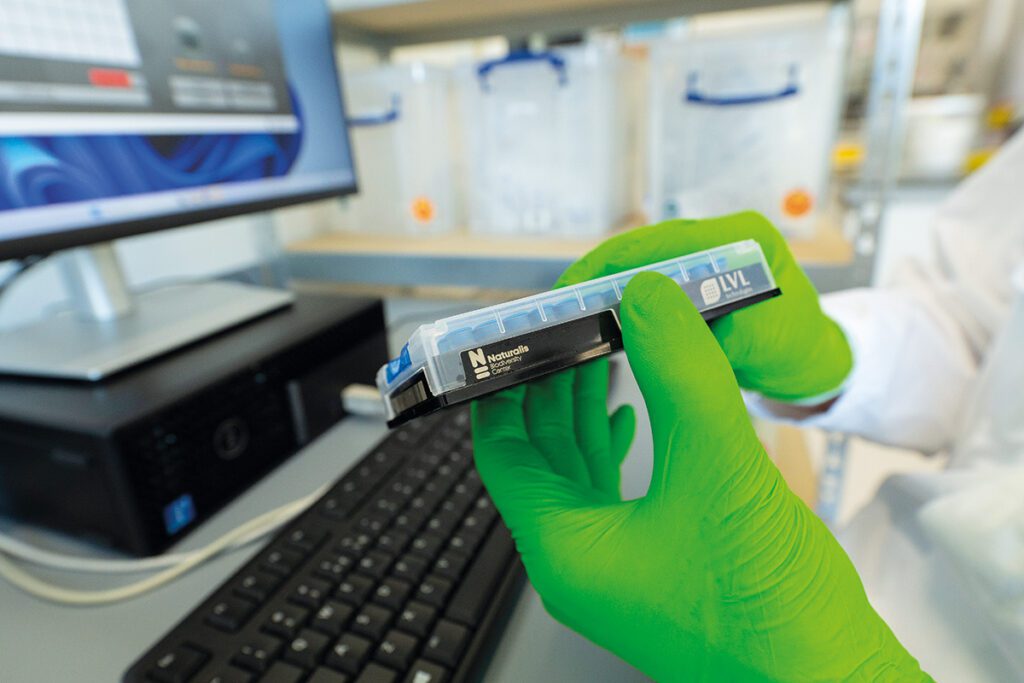
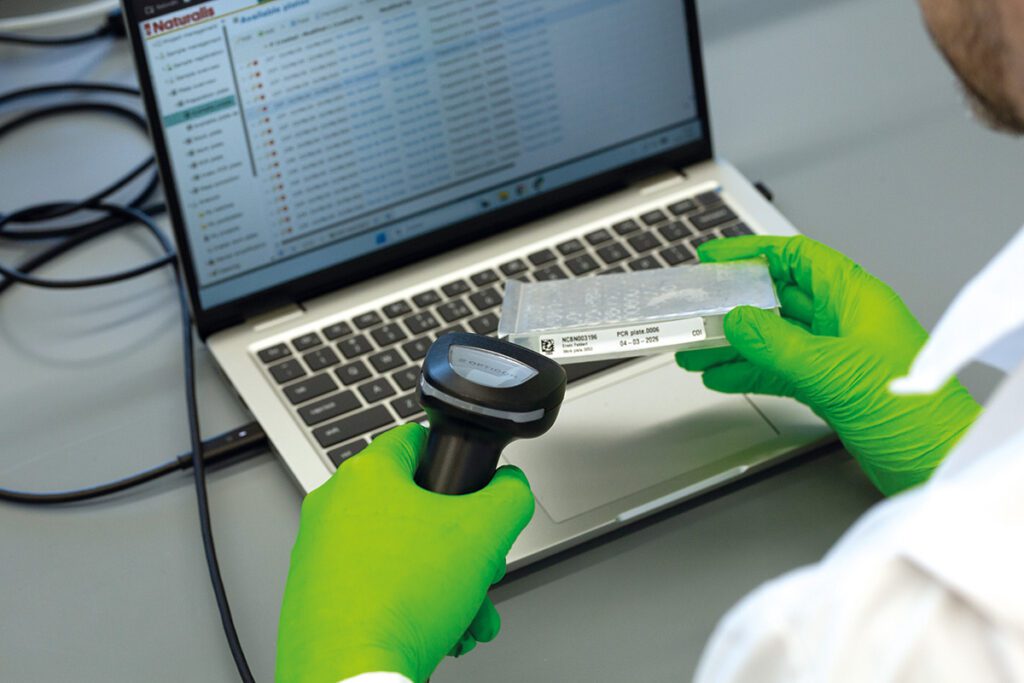
When scanning, all data — even when it originates in other systems — is passed through to the LIMS | Photo: FOODnote
Naturalis Biodiversity Center carries out thousands of laboratory analyses every year for biodiversity research. To keep quality in this field at the highest level, the laboratories have switched to a LIMS system. That switch did not go without a hitch, but was necessary for professionalisation. Registration is now structured and the data traceable from A to Z. Naturalis is ready for the future.
Naturalis Biodiversity Center is a leading institute within global biodiversity research. To safeguard the quality and reliability of its research programmes, Naturalis’s central lab has switched from separate lab notebooks to a reliable LIMS data system. A major step forward. All research data is now easily traceable, well-organised and properly recorded.
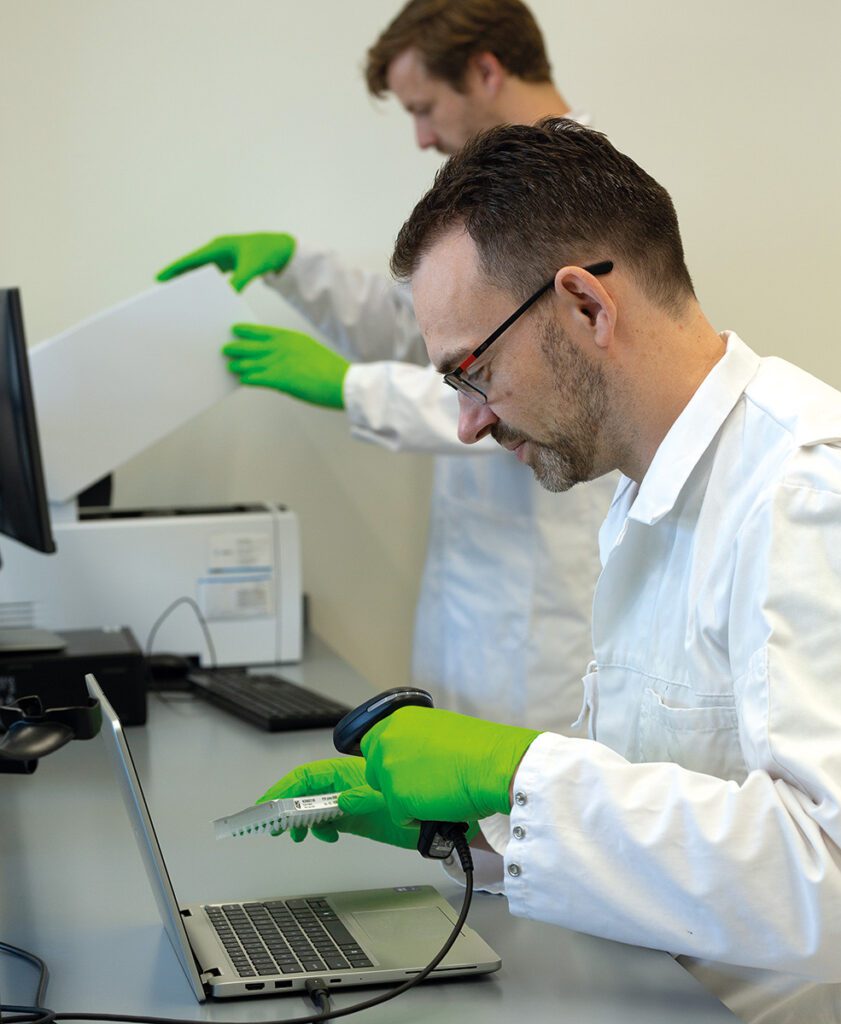
Senior researcher Erwin Fakkert scans a sample for registration in the LIMS, with colleague Marcel de Winter in the background | Photo: FOODnote
tk1 National research institute
Naturalis is best known to the public as a museum, and as the home of T. rex Trix. But behind the scenes, in the science building in Leiden, much more is going on. As a national research institute, Naturalis Biodiversity Center houses around 130 researchers, divided across eight research groups. Around 80 diverse research projects in the fields of (molecular) biology, morphology, and geology run here every year.
Naturalis’ laboratory, where some 23 staff members are active, functions as a centralised facility for both internal and external researchers. The lab supports a wide range of modern techniques, ranging from various DNA sequencing methods and ancient DNA research to advanced 3D CT scanning. Within the molecular lab, the focus is on workflows for DNA barcoding and metabarcoding, using Next Generation Sequencing (Oxford Nanopore and Element AVITI).
Groundbreaking projects
At the helm is Elza Duijm, head of the lab department. ‘Our ambition is to map the whole of Dutch nature,’ she explains. ‘Our laboratory therefore makes a crucial contribution to groundbreaking projects, such as ARISE, which focuses on identifying all Dutch species, and initiatives such as eDentity, with which we analyse DNA traces in soil, water, and air.’
Within the Naturalis Research Infrastructure (NRI), the institute is now building step by step towards one advanced, digital infrastructure for species recognition. Full use is being made of safeguarding FAIR data (Findable, Accessible, Interoperable and Reusable). Within this infrastructure, scientific expertise comes together with AI, natural history collections and modern techniques. This should make it possible to measure biodiversity in near real time and map the complete web of life more quickly.
tk2 From loose lab notebooks to LIMS
To realise these ambitions and process the immense amount of registration, collection and analysis data, working practices in the laboratory had to keep pace. It was precisely the scale of these current projects that caused the lab to outgrow itself. ‘The real eye-opener came during our first major biodiversity programme,’ Duijm explains. ‘In five years, we processed no fewer than 70,000 samples.’
‘At the time, we relied on separate lab notebooks, Excel and Google Sheets. That worked reasonably well, but back then we worked with a much smaller team and the projects were a lot more manageable. Once more people start working in an Excel file, there’s a greater risk of human error. Moreover, we still worked with handwritten lab notebooks. Just try reading back someone’s data after a few years, from handwriting nobody can decipher …’
The laboratory ran up against the limits of its system, says Duijm. And as a result, the quality of the data was at stake. The choice was quickly made, and LIMS was given top priority.
“We ran hard into the limits of our own system”
Elza Duijm, Naturalis Biodiversity Center
tk3 Requirements programme
The search for a professional data system actually began back in 2022 and will only be completed this year (end of June). Duijm is glad it’s almost done. ‘We’re now more than 2.5 years into the process since the completion of the European tender, and we’re currently putting the finishing touches on the implementation. It’s been an extremely intensive process, in which we’ve learned and overcome a great deal.’ She continues: ‘Because we had to start from scratch, we spoke extensively beforehand with other organisations that already had experience with a LIMS. That gave us a good picture of how best to approach the tender process and the subsequent implementation. That helped us enormously.’
Naturalis Biodiversity Center’s requirements programme was a very extensive list. Budget and alignment with existing workflows and databases naturally played a major role. On top of that, the LIMS had to be able to handle enormous batches of data, while at the same time being intuitive enough for the smaller-scale work of individual researchers. Sustainability, digital security and the accompanying service were at least as important.
‘It was mainly the large numbers and the flexibility that turned out to be a dealbreaker for many suppliers,’ Duijm recalls. ‘iVention did dare to go into business with us with their iLES data system, even though this was a challenging project for them too. It’s fantastic that they took this on with us, and the result speaks for itself.’
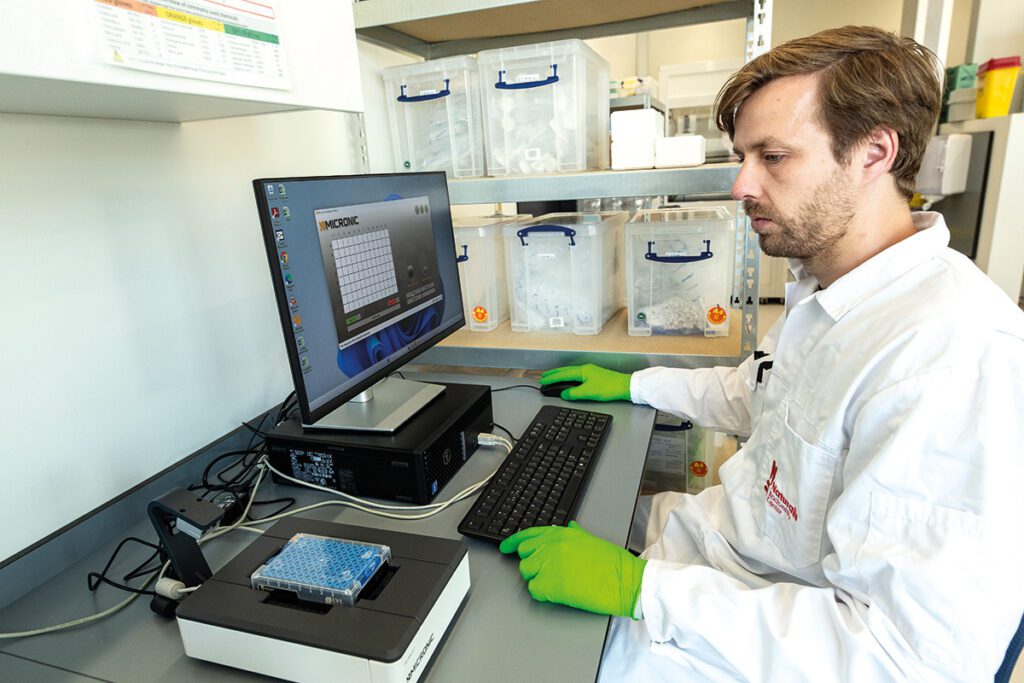
Scanning a 96-well plate on a Micronic card reader; all data is passed through to iLES | Photo: FOODnote
tk4 Intensive implementation phase
Besides the supplier’s efforts, around ten staff members internally have been working on the iLES project: a project manager, data specialists and the analysts who work with the molecular workflows daily. Duijm: ‘Everyone thought intensively about what we really expected from the LIMS. To accomplish that, we had to critically examine every step on the lab floor.’
Over the course of the process they discovered that this isn’t easy. ‘As a lab worker, you do some tasks so automatically that it’s difficult to explain them to someone else in detail. And we found that our professional jargon caused misunderstandings. For us, words like index, sample and barcode simply mean something entirely different.’
“Carry out the testing phase in small steps; that way you keep better oversight”
Elza Duijm, Naturalis Biodiversity Center
Testing, testing, testing…
The biggest and most time-consuming puzzle turned out to be translating the old way of working into a functional design and back again into the new way of working. ‘Partly because of all those new procedures and our lack of prior LIMS experience, testing turned out to be a huge job that took more time than we had anticipated beforehand.’
Two tips Duijm wants to pass on to others: ‘Carry out the translation into a functional design together with the testing phase in small steps; that way you keep better oversight. And also realise that a LIMS isn’t perfect. It’s a registration system, not a miracle tool. Keep it simple.’
“iLES is a registration system, not a miracle tool”
Elza Duijm, Naturalis Biodiversity Center
tk5 Quality and reliability
By the end of this month, the Naturalis lab hopes to have iLES fully up and running. ‘We’re definitely going to mark that moment,’ says Duijm. ‘They were a few tough years, but thanks to the tireless efforts of iVention and our team, we’ve together built a wonderful platform that processes huge batches and in which all our molecular workflows are flawlessly recorded.’ For the future, the overall quality and reliability of biodiversity research have been safeguarded. Not only is the registration of the data now structured, but so is the transparency and traceability. ‘We now have a future-proof system that works both for the large-scale lab work of our mega-projects and for the smaller projects of individual researchers.’
LIMS ambitions
Any wishes for the future? ‘In practice, we’re bound to come across things that could be made even more efficient; that’s part of such a large project. Our priority now is to get everyone in the lab acquainted with iLES. Over the next six months we’re going to use the system intensively and gather all the feedback and optimisation ideas, after which we’ll take stock for the next round of improvements.’
A major wish for the longer term is to register the morphological and geological workflows (CT scans, SEM) in the LIMS as well, alongside the molecular workflows. Naturalis’ ambitions and the possibilities with this data system will only continue to grow.
Five benefits of iLES / LIMS for Naturalis Biodiversity Center
- End-to-end workflow registration: all process steps integrated into one system.
- Working with 96-well plates: batch processing possible; no more registering actions per sample individually.
- Unique identification and tracking: automatically generated unique IDs for scannable, low-error process steps.
- Improved data consistency and overview: all data centrally available.
- Efficiency and error reduction: manual steps minimised through automation.