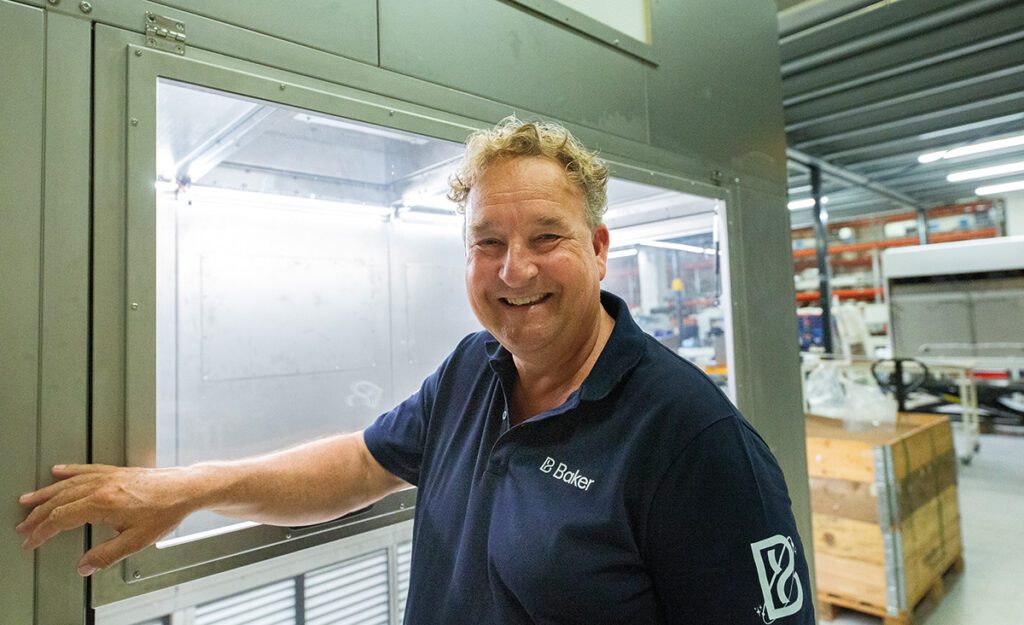
Diko Strietman | Photo: FOODnote
The major trend in laboratory safety in pharma and life sciences over the coming years is the contamination-free operation of large laboratory instruments and analysers inside dedicated biological safety cabinets. According to managing director Diko Strietman of The Baker Company, these ‘safety enclosures’ are increasingly being applied for pipetting robots, flow cytometers and other robotics and automated processes, among others. “A large instrument generally does not fit inside an ordinary biological safety cabinet. That is why we develop more spacious, specially designed solutions to safeguard exposure risks.”
Diko Strietman has seen demand for these enclosures increase over the past three years. Above all, from the pharmaceutical sector, where safety trends of this kind are often the first to become visible. “The rise of tailor-made medicine is one of the drivers. You see more and more hospital pharmacists producing specific therapies themselves, for example, because otherwise it becomes unaffordable. That does, of course, have to be done safely.” In collaboration with laboratories and leading suppliers such as Eppendorf, Becton Dickinson, Sartorius, and Sony, BSCs have been developed with optimised air patterns: “Which match the equipment to be installed perfectly. This prevents contamination of the product, operators, and the laboratory space. Applications for this type of BSC enclosure include pipetting stations, centrifuges, and flow cytometers. And 3D tissue printing equipment as well.”
How does that work with a flow cytometer, for instance? Surely that is already housed in a sturdy, hermetically sealed casing? “Certainly, and yet material can still escape into the surroundings despite the casing of the equipment, if a sample tube breaks, for example”, Strietman notes. “The casing protects, but not one hundred per cent.”
tk1 Myths debunked
To train users in working safely in environments with potential contamination risks, training tools have been developed, including the ‘Mythbusters’. “With this programme we examine questions and myths in the laboratory based on scientific facts and analyses.” Fact-checking, in other words. Take the question: ‘Do large lab machines require an enclosure to maintain protection?’. In many a laboratory this is not considered at all, Strietman knows. The equipment simply sits on a laboratory bench, and only very occasionally inside a safety cabinet. But that can offer a false sense of security because a standard BSC does not necessarily provide sufficient protection against contamination.
Strietman: “Many systems of this kind – think of flow cytometers or centrifuges – have an aerosol management system built in to capture unwanted particles, but it never becomes safe. A risk remains that contamination is released into the room because a vial breaks, for example. This has also been demonstrated by ‘the International Society for the Advancement of Cytometry Cell Sorter Biosafety Standards’.” Such an instrument is too large for an average biological safety cabinet. Strietman: “You disrupt the laminar flow. A smoke test demonstrates visibly that this does not work. That is only possible in an enclosure.”
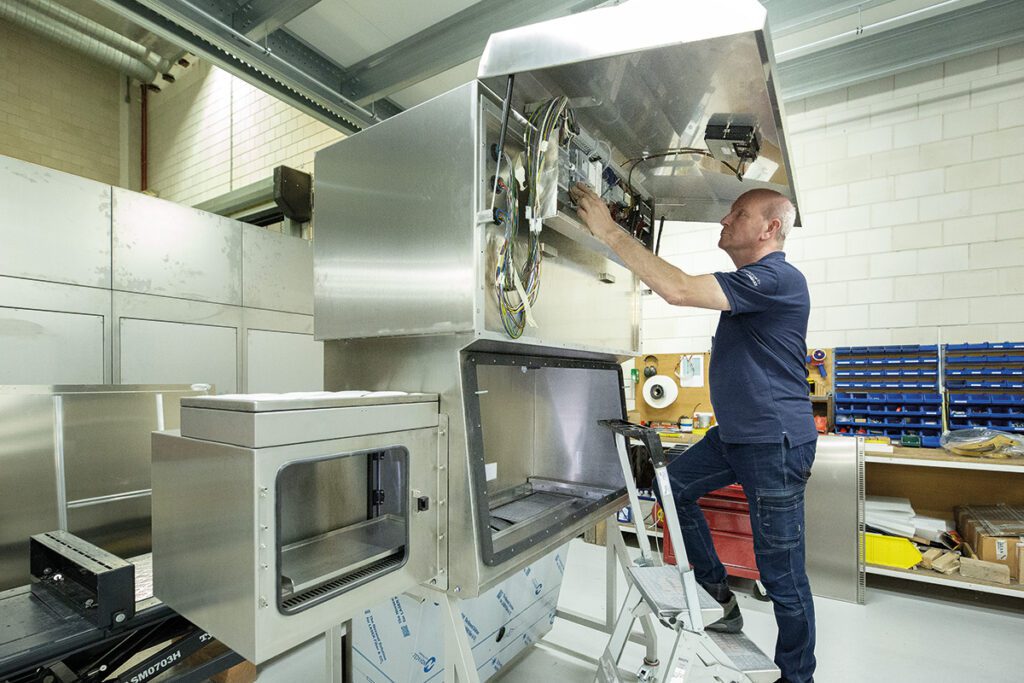
A technician puts the finishing touches on a containment isolator during manufacturing at The Baker Company | Photo: FOODnote
“Widespread misconception: placing equipment inside a safety cabinet automatically means that work is being done safely”
Diko Strietman, The Baker Company
tk2 Centrifuges and pipetting robots
With centrifuges, the release of aerosols or cells through centrifugal forces is not so difficult to imagine. “In a centrifuge, particles are ejected forcefully from ventilation openings, so an enclosure is appropriate there.” With automated liquid handling, the release of aerosols is an underestimated phenomenon. It can occur through the blow-out function used to get the last drop out of the tip. Liquid can also creep upwards along the outer wall of the pipette tip during pipetting because of surface tension, and subsequently enter the room via air flows. In addition, the principle of air displacement can lead to the release of air bubbles containing material, or droplets can be released if the viscosity of the liquid varies. Can exposure not be prevented by placing the robot inside a standard BSC? Strietman: “That is the question. You do have to consider whether your automated pipetting station fits inside. If it is too large, safety is not guaranteed.”
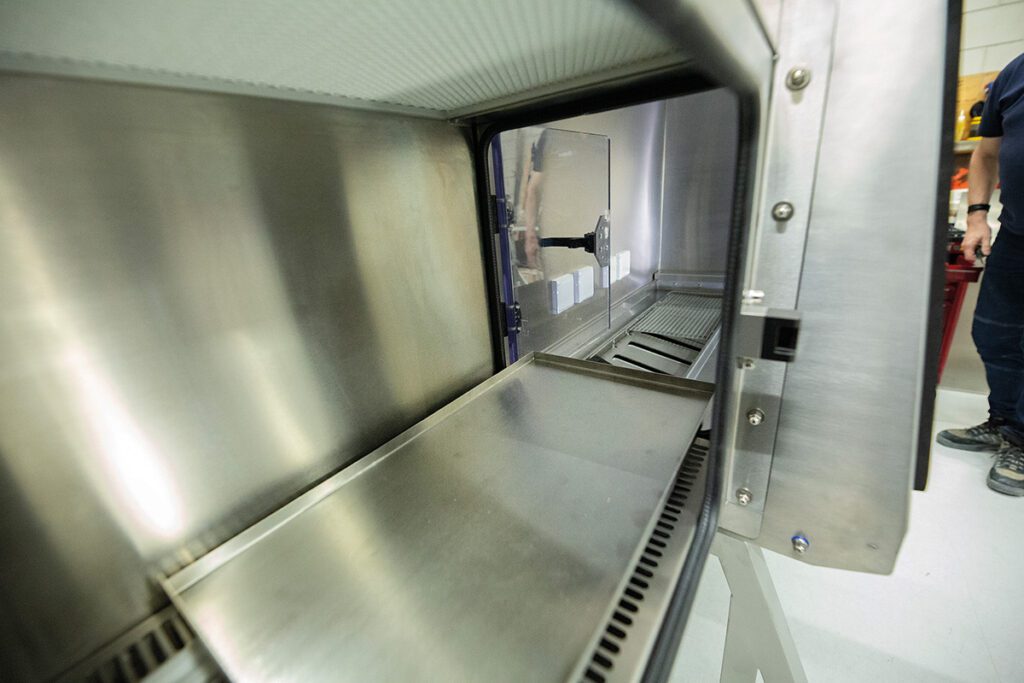
A transfer hatch to bring samples inside safely | Photo: FOODnote
tk3 Generously sized safety cabinet
In short, an enclosure has to be ‘fit for purpose’. “A widespread misconception is to think that placing equipment inside a safety cabinet automatically means that work is being done safely. For this we have developed more spacious cabinets, such as the EUROFLOW 6 with a continuous work surface and hinged at the front.” More generously sized, in other words. Placing equipment too tightly on its air grilles affects the flow in the cabinet and can disrupt it, causing particles to escape after all. Certainly when an operator is at work. A laminar air flow can become turbulent in that way, exactly what is not intended. “Test set-ups also show that you have to adapt the design of the equipment if you place it in an enclosure. For manufacturers of laboratory equipment, for example, we develop a rounded top cover, so that the flow glides along it nicely. With a flat top, the laminar flow is disrupted.”
“For laboratory equipment we develop more spacious, specially designed solutions to safeguard exposure risks”
Diko Strietman, The Baker Company
tk4 Biosafety levels 1 to 4
Walking through The Baker Company production department in Utrecht (the Netherlands), a technician is putting the finishing touches to such an enclosure, including a transfer hatch to bring samples inside safely. This special version is generously sized, so that large instruments fit into it easily. Strietman explains: “And in this specific version there is an isolator that is completely screened off from the laboratory environment.”
The ventilated enclosures that The Baker Company offers are available for biosafety levels 1 to 4. In their construction they have in common that they all contain HEPA filters, duplicated depending on the application, and they have a motor and blower for the laminar flow and extraction. They run partly on recirculation. Containing the risks of particles being released from laboratory equipment is also possible with a ‘flexible wall isolator’. This is a transparent, flexible plastic enclosure. Cost-saving, but there are drawbacks. “You cannot access it as easily, it does not last as long and it is less effective. Also, more difficult to keep clean and to decontaminate.”
tk5 More environmentally friendly decontamination
Speaking of disinfection. Hydrogen peroxide (VHP) is increasingly being applied to decontaminate the biosafety solutions and isolators mentioned after use. This can now also be done adequately with far lower VHP doses than in standard procedures, which is considerably more environmentally friendly. “We offer an option in which we can disinfect the entire unit within 2 hours using a relatively low percentage of hydrogen peroxide vapour. Bear in mind that isolators involve modest volumes, which means you can make do with less VHP. With 7.5% VHP, no specific chemical registration is required either, and it is far safer than formaldehyde, which has been phased out but is still in use.”
“We offer an option in which we can disinfect the entire unit within 2 hours using a relatively low percentage of hydrogen peroxide vapour”
Diko Strietman, The Baker Company
Downflow booth
For considerable equipment, an enclosed downflow booth offers a solution. “A completely enclosed system in which a robot operates. In consultation with the end user, access ports and/or doors are provided to be able to work on the system.” Installations of this kind are bespoke, similar to the BSC with transfer hatch under construction. So entirely tailored to the requirements of the user and the process. “Look how nicely it works. When you open that hatch, you can drive your trolley inside with the work. And then you can reach it again through the isolator gloves. Yes, that is quite something different from standard products, which we also manufacture here.”
Year of innovation at The Baker Company during WoTS 2026
Under the banner ‘Year of Innovation’, The Baker Company is dedicating 2026 to innovation and the modernisation of processes. Diko Strietman, managing director, says of this: “Over the past period we have developed various new technologies with which laboratories can make progress. During the WoTS Trade Show in Utrecht you can get acquainted with our technological breakthroughs. Visit us for this at stand E27 in hall 11.”
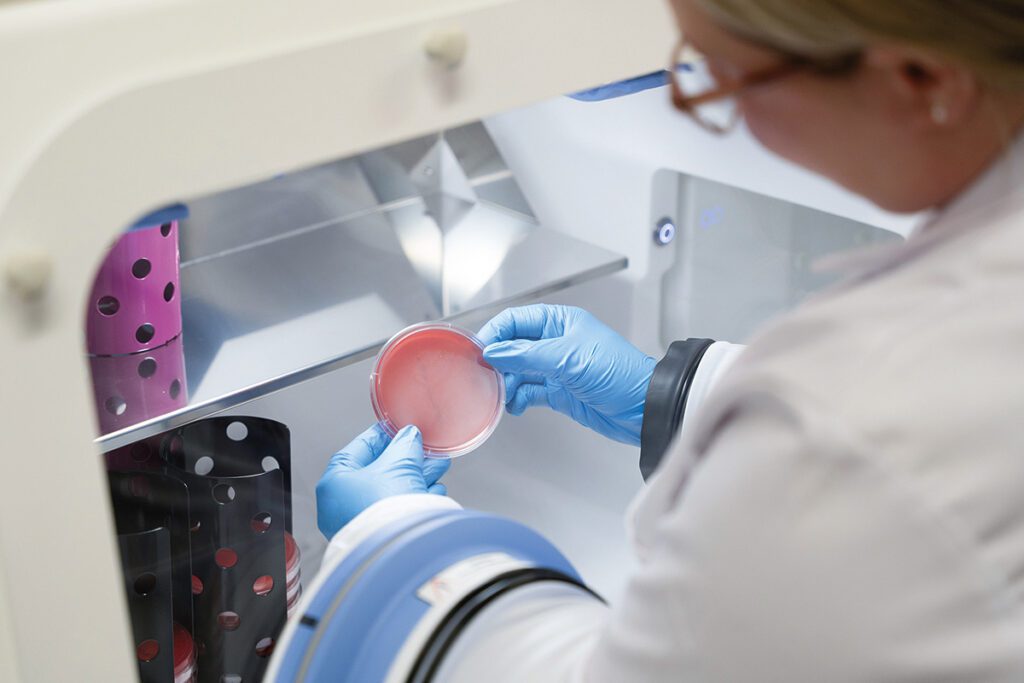
Hypoxia research using a specialized Baker workstation: the ‘Concept, performance by Ruskinn’
Acquisition of Ruskinn Technologies expands portfolio
With the acquisition of Ruskinn Technologies, a specialist in dedicated glove boxes/workstations, The Baker Company has expanded its portfolio for biological and medical research with laboratory equipment. This includes, in particular, culturing and studying cells and microorganisms under highly precise, controlled conditions. Among the products:
- Anaerobic workstations (oxygen-free environments for microbiology)
- Hypoxia and physiological oxygen systems to mimic the low oxygen levels in human tissue
- Cell culture and stem cell research
- Equipment for cancer research, molecular biology and regenerative medicine
The sealed workstations give researchers the ability to control oxygen, CO2, temperature and humidity very precisely. This allows cells to be studied under conditions closely resembling those in the human body. Applications lie in better treatments for cancer, among others, research on stem cells and returning them to patients, and the effect of oxygen shortages on sports and muscle functions. The field has been given a boost since the coronavirus pandemic, because of the need to arrive at vaccines more quickly. Interest in hypoxia was further fuelled by the discovery of the HIF-1-alpha protein (Hypoxia Inducible Factor). The Nobel Prize was awarded for this in 2019. This protein acts as a kind of ‘switch’ that activates the DNA in the event of oxygen deficiency and puts it into survival mode. Particularly interesting for research into tumour hypoxia, in which an oxygen-poor environment – caused by cell growth that is too rapid and blood vessel growth lagging – makes cancer cells more aggressive and resistant to chemotherapy or radiotherapy.