



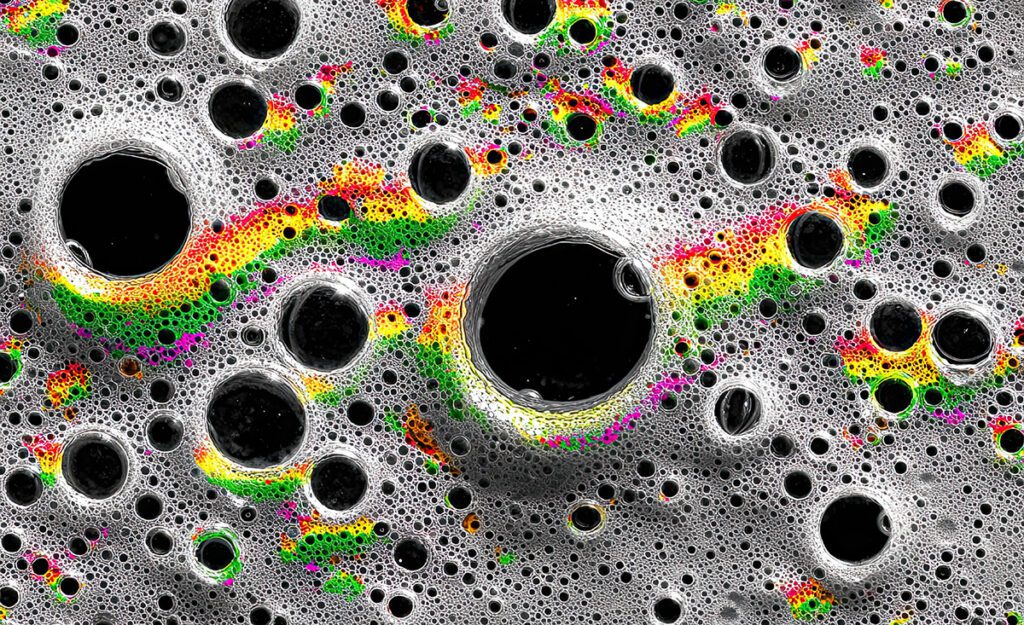
Formulators use surfactants in everything from personal care products and household cleaners to industrial processes and pharmaceutical formulations. They reduce interfacial tension and support emulsification, wetting, and dispersion, enabling formulators to develop products that meet performance requirements while maintaining formulation stability.
At Alfa Chemistry, we offer an extensive portfolio of surfactants and functional ingredients trusted worldwide for their quality, consistency, and the strong technical and regulatory support we provide. Here are eight of our best-selling surfactant and functional materials:
Industrial and institutional grade cleaning systems are where a lot of greasy and particulate soils are typically found. Triethanolamine dodecylbenzene sulfonate works exceptionally well in these cases by not only aiding in emulsification, but also providing a high degree of detergency as well. As an anionic surfactant, it is highly effective at interacting with oily soils and helping break them down. However, it is also compatible with many surfactants, which allows formulators to adjust their overall strength and foam profiles.
It is used in many industrial and heavy-duty cleaners, surface disinfectants, or specialty detergents where a high degree of cleaning power is needed.
For formulations requiring moderate cleansing performance, 1-hexanol serves as a useful surfactant-like ingredient. It works well at removing soils while keeping surface substantivity and mildness. It is often used in personal care products where cleansing is required without the aggressiveness associated with stronger detergents.
In addition, it aids in wetting and solubilization when used in mixed surfactant systems. It can help with the overall processing of a formulation while contributing to a smoother product feel. Specialty household cleaners and personal care cleansers are typical applications of this ingredient.
N-Methyl-DL-aspartic acid is an amphoteric surfactant. Amphoteric surfactants are surfactants that can be positively or negatively charged based on the pH. They typically are very mild and are perfect at interacting with anionic, cationic, and nonionic surfactants.
This ingredient improves foam quality and mildness when added to a formula. It is particularly suitable in formulations that require improved performance while maintaining stability and mildness.
Dimethicone is not technically a surfactant. However, when it is paired with something that cleanses, it can help formulas spread more readily, feel better on the skin, and improve barrier properties.
Creams, lotions, and topical pharmaceuticals use this ingredient to not only improve sensory feel but also to leave a film that helps products feel silky and luxurious.
Polyglyceryl stearate is a nonionic surfactant often used to help emulsify oils into water. As a nonionic surfactant, it is less affected by ionic strength and can pair well with surfactants of any charge.
Typically used to help promote uniform dispersion of actives and stability of emulsions over time, this versatile ingredient is found in lotions, creams, and specialty emulsions.
Sodium cocoyl glutamate is an amino-acid derived, anionic surfactant. Formulators are finding many uses for this surfactant because it is mild, biodegradable, and skin-friendly. This surfactant offers great cleansing while maintaining the gentleness needed for today’s skincare products.
It is found in many baby care products, shampoos, and facial cleansing formulations.
Lactose is another functional ingredient that is not a surfactant. It is typically used as a carrier and dispersing aid in powdered or solid dosage forms. Lactose helps promote the uniform distribution of actives and improves flowability, processing performance, and content uniformity.
You will find lactose in many pharmaceutical systems where consistent blending and dosing are critical.
L-Thioproline is another amphoteric surfactant. It helps provide a higher degree of mildness to formulations as well as increased stability. Similar to N-Methyl-DL-aspartic acid, it can be used with anionic and nonionic surfactants.
Formulators can use this surfactant to help boost cleansing efficiency while maintaining a high degree of mildness.
At Alfa Chemistry, we are a global supplier of anionic, cationic, nonionic, and amphoteric surfactants as well as many other functional ingredients used throughout multiple industries.
We don’t stop at just supplying products. We also offer technical service, regulatory support, and global shipping solutions to help customers confidently develop high-performance formulations. Whether the goal is to increase cleansing ability, stabilize emulsions, improve dispersion, or enhance product sensory properties, Alfa Chemistry supports the development of reliable and effective formulations.
